Insights · NRI Tax
NRI Residential Status for Indians in the UAE: 182 Days, 120 Days and Deemed Residency
The residence tests in section 6 of the Income-tax Act, 2025 applied to Indians living in the UAE, with five common situations and what RNOR status means on return.
Most Indians working or running a business in the UAE are non-resident in India for tax, and their UAE income is not taxed in India. But that status is decided afresh every Indian tax year by counting days, and two rules added in 2020 catch people who visit often or who earn significant income in India. The Income-tax Act, 2025 carried the same tests into section 6 from 1 April 2026. This guide explains them with the situations we see most among clients in Dubai and Abu Dhabi.
Key points
- You are resident if you spend 182 days or more in India in the tax year (1 April to 31 March)
- You are also resident at 60 days plus 365 days over the previous four years, but that test does not apply to Indian citizens who left for employment abroad, or to Indians visiting whose Indian income is Rs 15 lakh or less
- A visiting Indian citizen or PIO with Indian income above Rs 15 lakh becomes resident at 120 days (plus 365 days over four years)
- An Indian citizen with Indian income above Rs 15 lakh who is not liable to tax in any country by residence or domicile is deemed resident
- Anyone resident only under the 120-day or deemed residency rule is RNOR, so foreign income stays outside Indian tax unless it comes from a business controlled or a profession set up in India
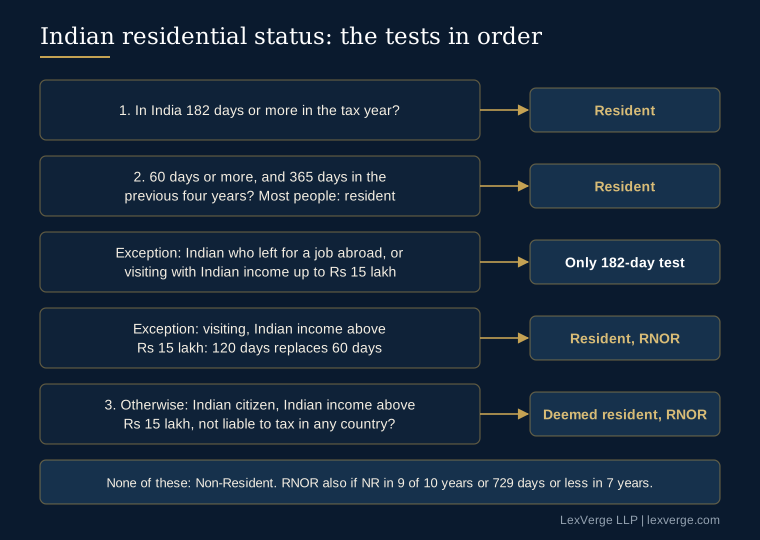
The tests, in the order to apply them
- 182 days. 182 days or more in India in the tax year makes you resident, whatever your citizenship or income.
- 60 days plus 365 days. 60 days or more in the year, and 365 days or more in the four preceding years, also makes you resident, with two exceptions for Indian citizens and persons of Indian origin. If you left India during the year for employment abroad (or as crew of an Indian ship), the 60 days becomes 182. If you live abroad and come to India on visits, the 60 days becomes 182 where your Indian income is Rs 15 lakh or less, and 120 where it is more.
- Deemed residency. An Indian citizen whose total income, other than income from foreign sources, exceeds Rs 15 lakh, and who is not liable to tax in any other country by reason of domicile, residence or a similar criterion, is deemed resident regardless of days.
“Indian income” for the Rs 15 lakh tests means income other than income from foreign sources: rent from Indian property, interest on NRO deposits, capital gains on Indian shares, mutual funds or land, and Indian business income all count. Interest on NRE deposits, which is exempt for a non-resident, generally does not add to taxable income. Count both the day of arrival and the day of departure as days in India; that is how the department counts, and disputes over single days are common.
Deemed residency and the UAE
The UAE does not levy personal income tax on employment or investment income, so a UAE-based Indian citizen with more than Rs 15 lakh of Indian income can look like someone “not liable to tax” anywhere. When the rule was introduced in 2020, the CBDT issued a press release saying it was not intended to bring into the tax net Indian citizens who are bona fide workers in other countries, including the Middle East. The law was also framed so that a deemed resident is always “resident but not ordinarily resident” (RNOR). The practical result is that UAE salary and other foreign income of a deemed resident is not taxed in India unless it comes from a business controlled in, or a profession set up in, India. What changes is compliance: the person files as a resident, and some non-resident concessions stop applying.
A UAE tax residency certificate is the best evidence that you are resident in the UAE. It helps with the deemed residency question and with treaty claims. Our guide to the UAE tax residency certificate for Indians covers eligibility and the process.
Five situations we see often
| Situation | Result |
|---|---|
| Salaried in Dubai since 2021, visits India 70 days a year, Indian income Rs 4 lakh (NRO interest and rent) | Non-resident. Visiting Indian with Indian income up to Rs 15 lakh, so only the 182-day test applies |
| Business owner in Dubai, visits India 130 days, Indian rent and capital gains Rs 22 lakh, spent more than 365 days in India in the last four years | Resident under the 120-day rule, and RNOR. UAE business income is not taxed in India unless the business is controlled from India |
| Moved to Abu Dhabi for a job in July, having spent 100 days in India in the tax year | Non-resident for that year. Leaving for employment abroad means the 182-day test applies |
| Lives in Dubai, visits India 40 days, Indian income Rs 30 lakh, holds no tax residency certificate anywhere | Risk of deemed residency, and if so RNOR. A UAE TRC and the facts of UAE residence should be documented |
| Returning to India permanently after twelve years in the UAE | Resident in the year of return, but usually RNOR for up to two or three years, so foreign income in that window is generally not taxed in India |
RNOR, and why it matters when you come back
A resident is “not ordinarily resident” if they were non-resident in nine of the ten preceding years, or spent 729 days or less in India in the seven preceding years. People who are resident only because of the 120-day rule or the deemed residency rule are always RNOR. An RNOR is taxed like a non-resident on foreign income, except income from a business controlled or profession set up in India. For a returning NRI, this window is the time to restructure foreign accounts, decide what to bring back and what to keep, and plan the sale of foreign assets. Once you become ordinarily resident, worldwide income is taxable in India and every foreign asset must be reported in Schedule FA.
For the Indian day-count tests on their own, including how each status changes what India taxes, FilingBase, our online compliance platform, has a plain-English guide to residential status under Indian income tax.
When the treaty decides
If India treats you as resident under its domestic rules and the UAE also treats you as resident, the India-UAE tax treaty’s tie-breaker decides which country has the primary claim, looking at your permanent home, centre of vital interests and habitual abode. The treaty route needs a UAE TRC, and it does not change the Indian filing obligations that come with resident status. See the India-UAE treaty for how relief works.
Practical steps
- Keep a day count every tax year from passport stamps or immigration records; do not rely on memory in March.
- Watch your Indian income against Rs 15 lakh, especially in a year when you sell Indian property or shares.
- Hold a UAE TRC if you are close to either threshold.
- Keep NRO and NRE accounts correctly designated, and redesignate them when your status changes.
- Plan a return to India a year ahead so the RNOR years are used well.
Our residential status checker applies these tests to your numbers in a minute, and our NRI tax advisory team handles residency analysis, Indian returns and the UAE side for Indians living in the Emirates.